
08
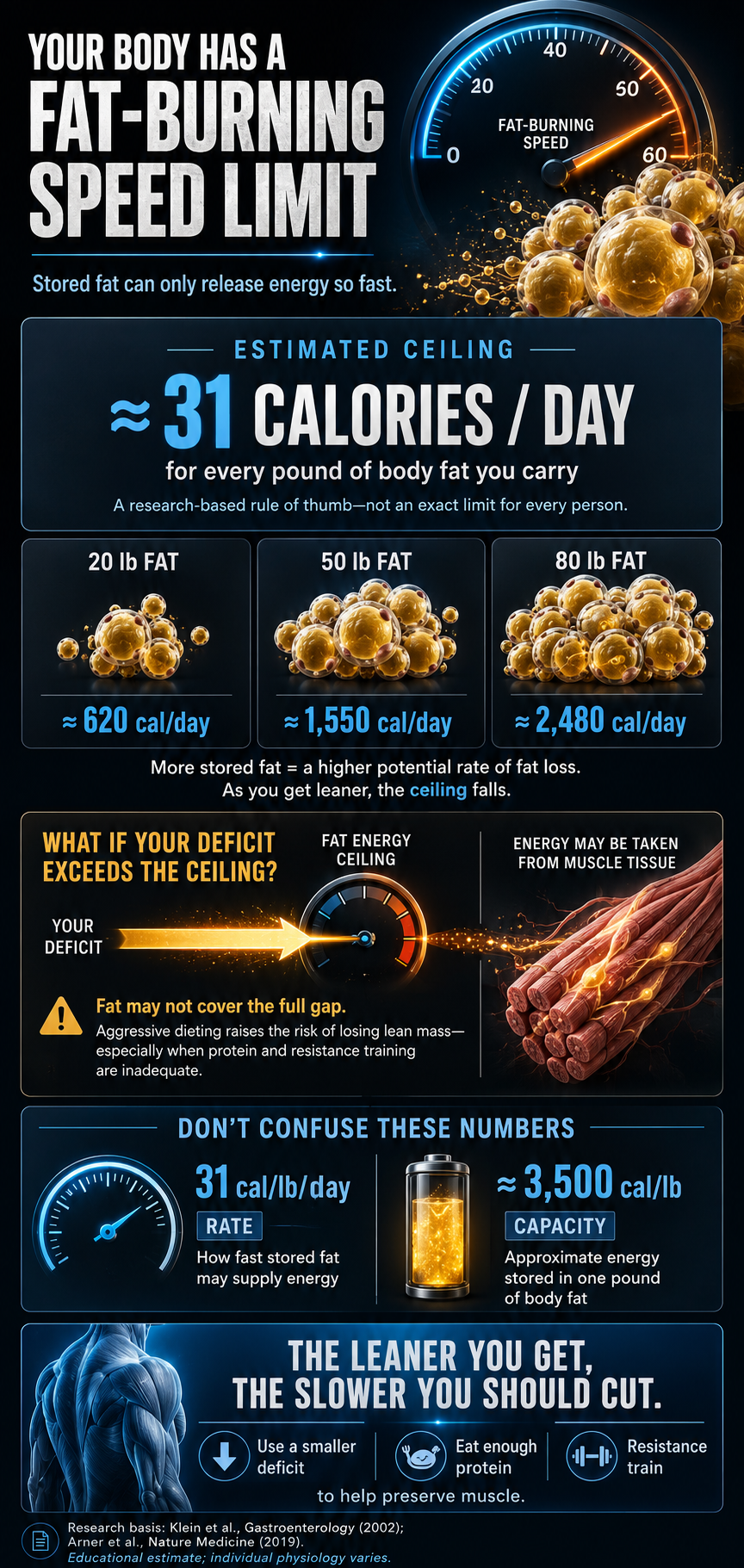
Your body has a fat-burning speed limit
Reference: Klein et al., Gastroenterology (2002); Arner et al., Nature Medicine (2019)
Stored fat can only release energy so fast. Push the deficit past that ceiling and muscle starts paying the bill.
You can only pull energy out of stored fat so quickly. A useful research-based rule of thumb is about 31 calories per day for every pound of body fat you are carrying. That is a ceiling, not a promise, and not an exact limit for every person.
The more fat you have, the higher that potential rate. Roughly: 20 lb of fat ≈ 620 calories a day. 50 lb ≈ 1,550. 80 lb ≈ 2,480. As you get leaner, the ceiling falls. That is why the last 10 pounds feel slower than the first 30, and why a deficit that was fine at a higher weight starts chewing on muscle when you are already pretty lean.
Do not confuse the rate with the tank. About 31 calories per pound per day is how fast stored fat may supply energy. About 3,500 calories per pound is the approximate energy stored in one pound of fat. One is speed. The other is capacity.
If your daily deficit is bigger than that ceiling, fat may not cover the full gap. The rest tends to come from lean tissue — especially if protein is low and you are not lifting. Aggressive dieting is how people “lose weight” and still look softer.
The leaner you get, the slower you should cut. Smaller deficit. Enough protein. Resistance training. Same three moves as everywhere else on this site — they just matter more when the fat warehouse is running low.
Your numbers
Fat-burn ceiling
Fill in any two. The third fills itself. Then you get the ~31 calories per day per pound of fat ceiling — a rule of thumb, not a lab result.
The math
— lb fat×31=—
31 calories per day for every pound of fat on the body. That is the ceiling.
Enter any two numbers above and this fills in.
Why we keep protein high in a deficit So the gap does not get taken from muscle.
General education, not a personal treatment plan. If you have a medical condition — kidneys, pregnancy, disordered eating, anything your clinician is already following — talk with them before you overhaul how you eat.