
05
The Protein × 10 Trick
Stolen from Dr. Ted Naiman
The front of the bag is advertising. Two numbers on the back tell you if it is actually a good option.
Food companies are not trying to make grocery shopping easy. They are trying to win the shelf. “Protein.” “Healthy.” “Organic.” “Made with whole grains.” That is the advertising major working for Kraft trying to one-up last quarter’s campaign. The label is designed to confuse you. The nutrition facts are the only part that has to tell the truth — and even then, you have to know which two numbers to trust.
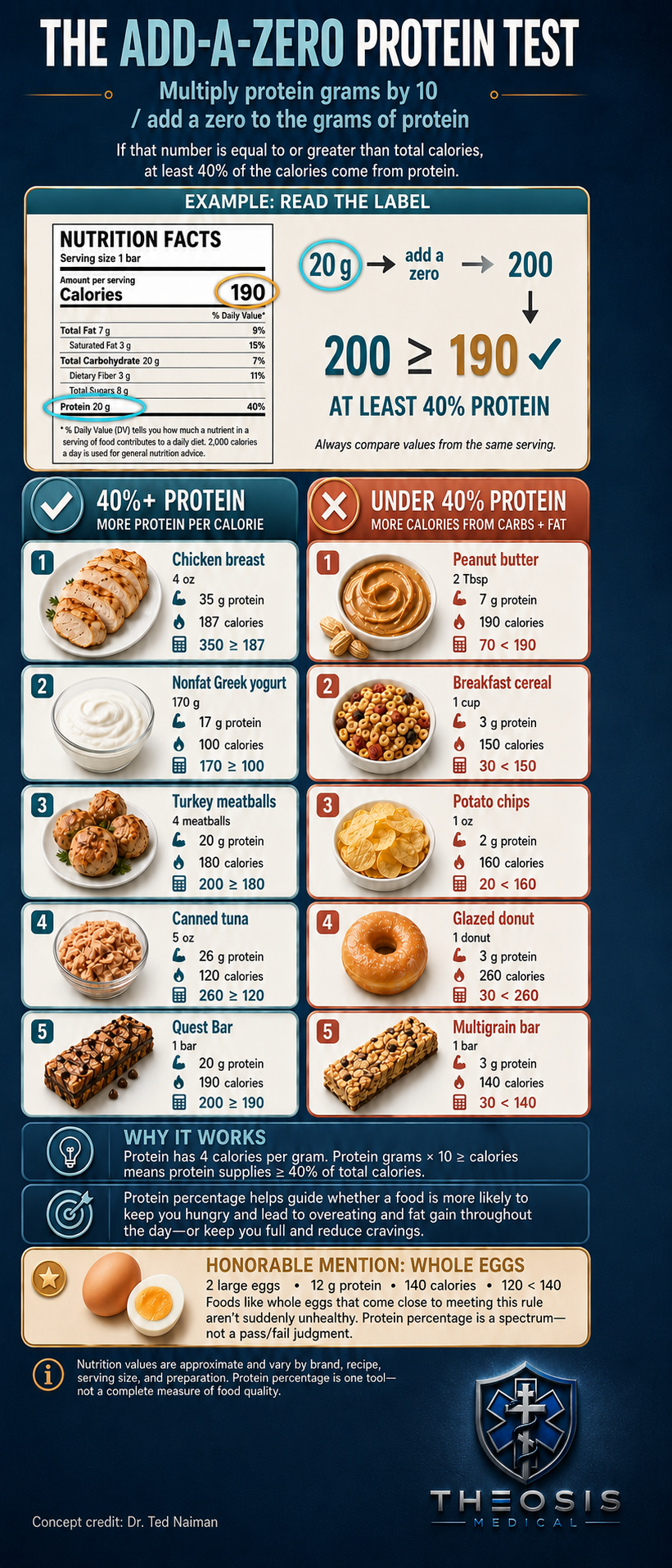
This one is not mine. It is Dr. Ted Naiman’s, and I use it every time I turn a bag over. The graphic below is his. I am showing it here so you can steal it the same way I did.
Find protein grams per serving. Multiply by 10 — or just add a zero. Compare that number to calories per serving. If protein × 10 meets or beats the calories, the food is at least 40% protein. That is the ideal.
You do not have to hit 40% every time. If it is 30% protein or more, that is still fine. A 30 g shake with low fat and carbs, a Legendary pastry, a Quest bar — some of those live in that band. The nerdier ranking is protein-to-energy: protein grams divided by carb grams plus fat grams. That is Dr. Naiman’s P:E ratio, and it is how the fast-food page is scored.
That is the whole grocery-aisle algorithm. Two numbers. One decision. No app, no macro spreadsheet, no falling for the front of the box. It also works on a fast-food screen if you bother to open the nutrition panel.
Why do we care about protein? It is not a gym-bro thing.
What do we mean by “energy”? Parts, fuel, and what the P:E numbers actually are.
Nutrition Facts
1 serving per container
Amount per serving
Look here. Compare this to protein × 10.
% Daily Value*
Total Fat —
Saturated Fat —
Trans Fat —
Cholesterol —
Sodium —
Total Carbohydrate —
Dietary Fiber —
Total Sugars —
Includes Added Sugars —
Protein 16g32%
Add a zero → 160. Steal it. The front of the bag didn't even have to lie.
*Calories and protein update from the boxes. The other lines stay blank on purpose — those two numbers are the trick.
Try a label
Protein × 10 vs calories
Pull two numbers off the panel. Hitting × 10 (40% protein) is the ideal. 30% or more is still fine.
A · 40%+
Protein × 10 = 160≥90 calories
Steal it. The front of the bag didn't even have to lie.
Roughly 71% of calories from protein (protein grams × 4 ÷ calories).
General education, not a personal treatment plan. If you have a medical condition — kidneys, pregnancy, disordered eating, anything your clinician is already following — talk with them before you overhaul how you eat.